


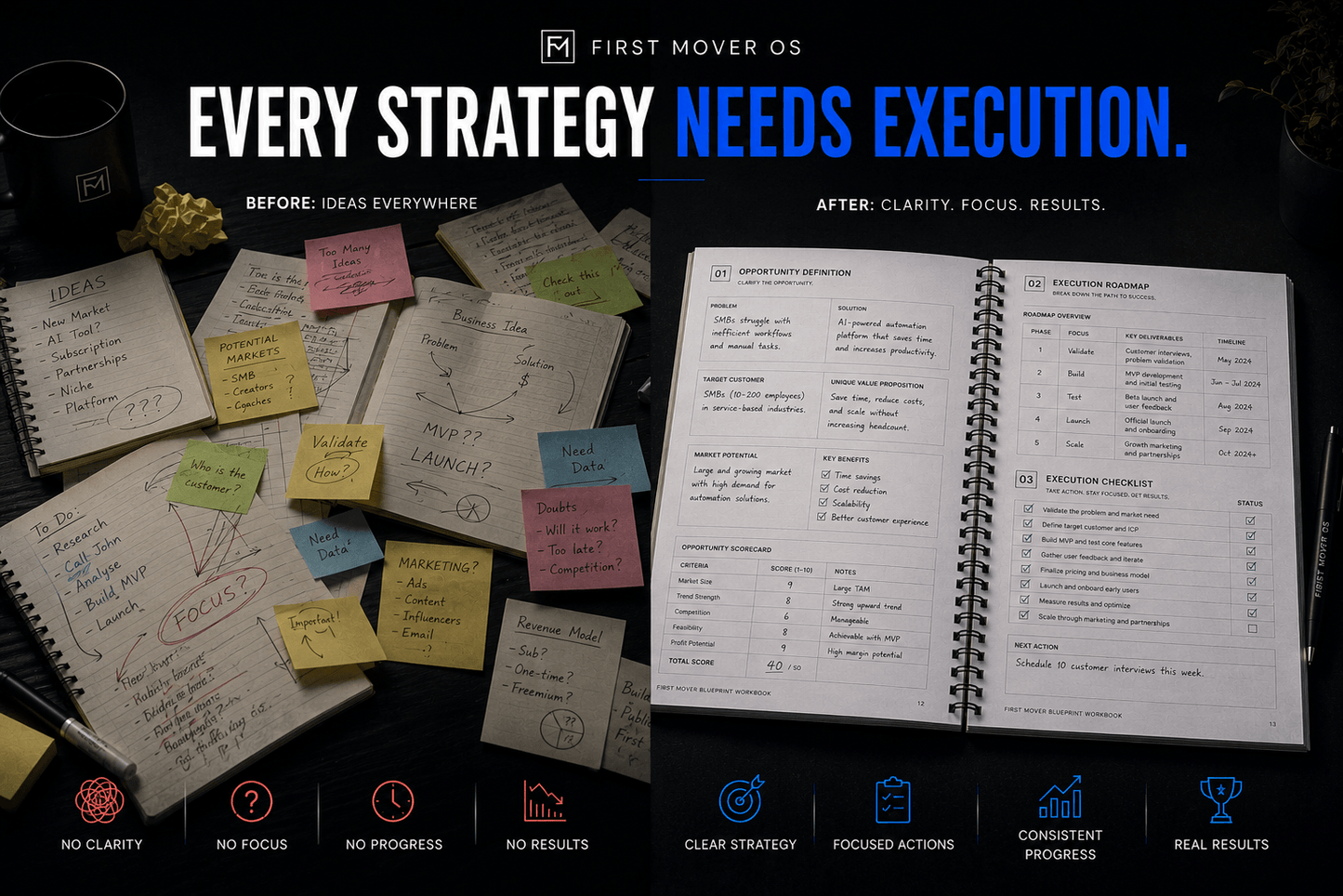

A Preview Inside First Mover OS

Lead the Shift - Don’t Chase It
“Execution transforms insights into tangible strategies. In this phase, you choose a specific opportunity, plan your next steps, and start acting on those plans. Whether it’s launching a pilot project, developing a new service, or shifting focus to a promising market sector, executing means taking bold, informed action. Here, you’re not merely reacting to trends—you’re stepping up and leading the charge to capitalize on emerging opportunities.”

Data Is Not a Strategy
“Many of us excel at understanding market data in theory but struggle to apply it under real-time pressures. Even with the right tools and metrics, our natural tendency is to overreact or second-guess our intuition. This can lead to missed opportunities and costly decisions. Without a disciplined mindset, the vast array of analytical data remains just that—data, rather than a roadmap for action.”

The Opportunity Is Hidden in the Noise
“Imagine trying to hear an important announcement on a busy street while raindrops, conversations, and traffic blend into constant background noise. You quickly realize that it isn’t about missing the message—it’s about learning how to tune your ears to the right frequency. In the same way, market data is full of noise. By learning to filter out the irrelevant, you position yourself to hear the clear, actionable signals that can transform your strategy.”

Hesitation Has a Cost
“In today’s fast-paced market, hesitation can cost you. A steady, signal-driven mindset shields you from overreacting to every deviation and helps you make timely decisions. The goal is to know when to react to important cues and when to ignore distracting noise, so you can move with greater confidence and agility instead of second-guessing every signal.”

Execution Is Only the Beginning
“After each decision period, review which signals you acted on and how they performed. Reflection allows you to fine-tune your judgement, while the lessons you collect help you adjust your signal-detection criteria. This creates a continuous improvement process in which every result becomes useful information and your strategy keeps evolving with changing market conditions.”


